
Recent Conversions When Can I Upgrade? AE Distribution Comparison Retirements Hiring vs Retirements History Demographics For New and Prospective Hires FAQ's
| A DISCUSSION ABOUT CAREER PROGRESSION.... |
| I get asked all the time about my estimated future seniority numbers and career progression. In this first part I'll show an example career and talk about why a career strays from what would be predicted at hiring. |
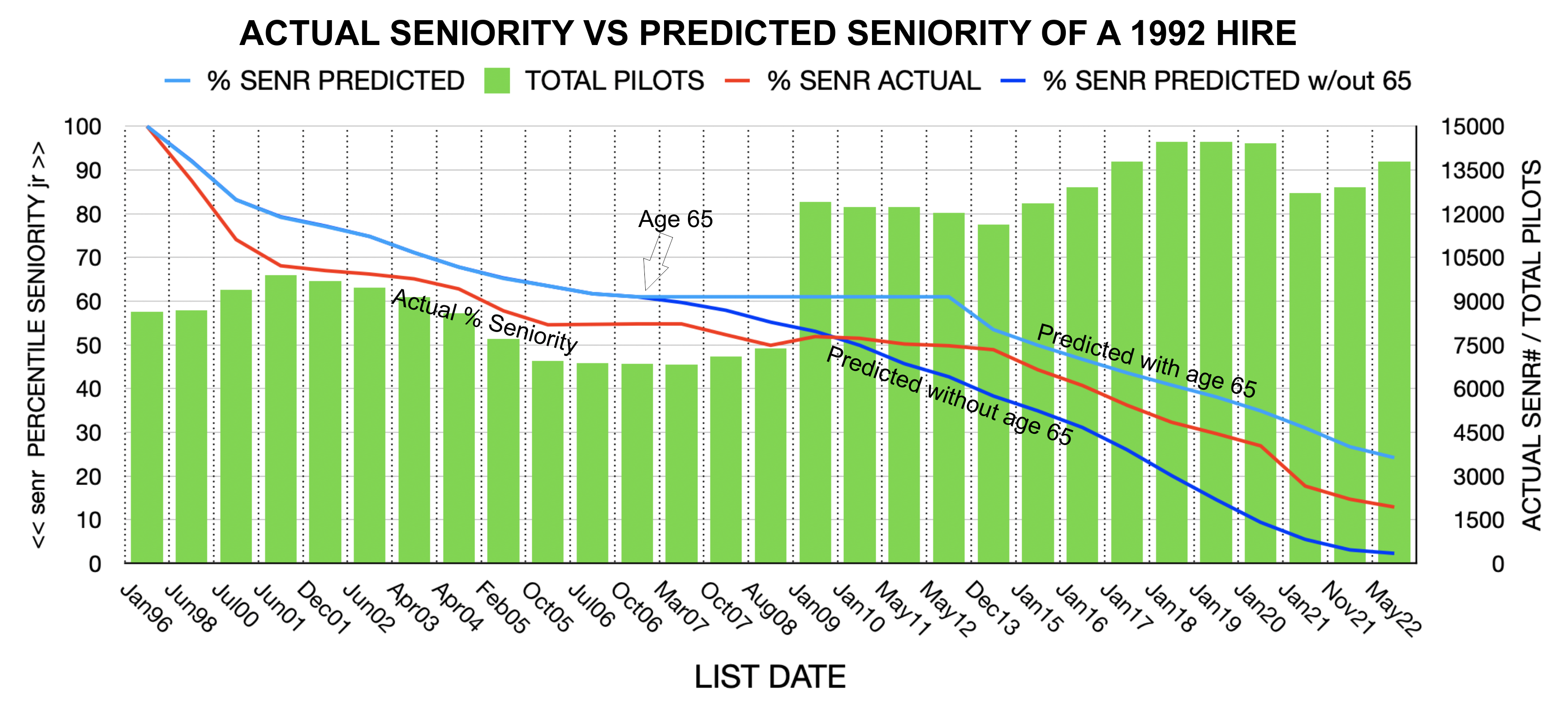 |
| For the discussion, I reference "percentile seniority." That is, what percent a pilot is of the whole pilot group. The reason I use it is that it's a better indicator of what a pilot can hold than one's actual seniority number. In the above example, percentile seniority is shown on the left scale. 100% is most junior. The light'ish blue line is what this pilot's percentile seniority would have been predicted to be. The red line is what it actually was. Each date along the bottom is an actual seniority list. You can see that any time the pilot group grows, the gap between predicted and actual percentile widens, and the pilot gets more senior, faster. Any time the pilot group shrinks, the pilot's percentile progression slows or even backtracks. Big economic events have a huge impact. For the pilot above, the early 90's stagnation were overcome by a few good years, 96-late 2001. Then 9/11 slowed his progression. Age 65- a response to the terminations of many retirement plans, almost stopped it cold. The merger hurt again, as the company, too large for the merged product, shrank for several years. Starting in 2013 things picked up again. Only to get smacked down by Covid, from which we are now (in 2021) mounting a recovery. EARLY RETIREMENTS I've spent a lot of time looking at Early Retirements and trying to figure out an algorythm that would give a more accurate future seniority prediction. The biggest problem is that under normal circumstances, early retirements rob Peter to pay Paul. IOW... every pilot senior to you who retires early depletes the number of pilots senior to you who will retire in future years. So... over the long run it SHOULD balance out. It doesn't... but I haven't figured out the right formula. The other problem with earlies is that in a downturn, they come in bunches. So pilots are leaving at the top and not being replaced. Everyone moves up... in theory. But they are chasing fewer Captain jobs. For many, any the positive affect is either diminished or completely negated. For now, I really haven't figured out a formula to predict earlies or their impact in a forward looking way. The moral of the story is, economics have a far greater impact on your career than early retirements. WAY bigger. Now, let's look at how past pilots have fared and see if anything can be learned... |
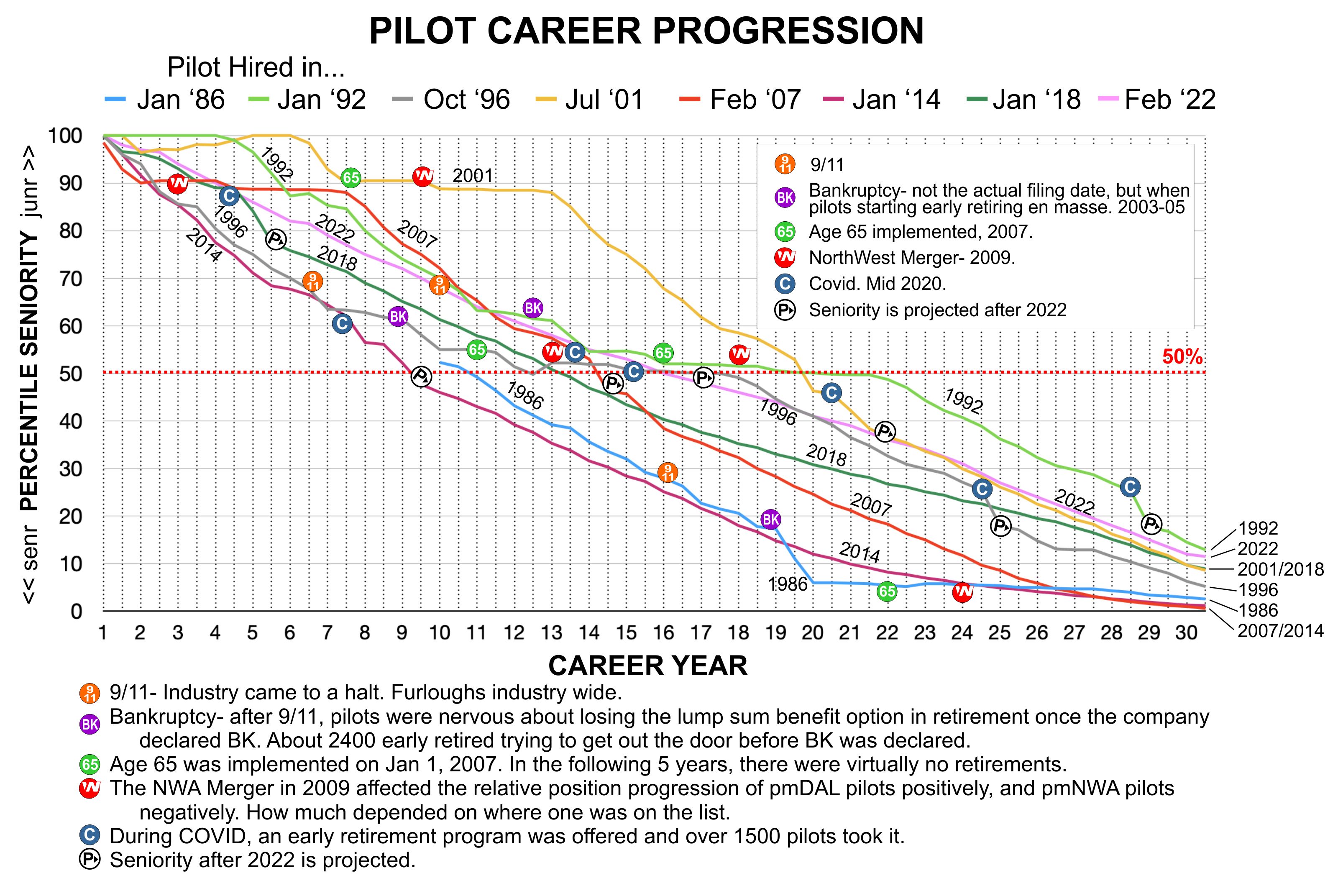 |
| The most obvious thing here is that WHEN one was hired is huge. And a matter of luck, frankly. The next thing to consider is how YOUNG one got hired. If you go visit the "Full Seniority List" page you can enter future years and see that the senior most pilots were overwhelmingly hired very young. You can't escape that. All that being said, what ISN'T reflected in the above chart is the impact of mergers/acquisitions. I lived through 3- Western in the late 80's. Pan Am in the early 90's and Northwest in 2008-9. I was an 86 hire. I was very junior for the Western and Pan Am events, and a junior Captain for NWA. And you can't look at that chart and say an 86 original DAL hire suffered. The Western, Pan Am and Northwest pilots would of course have a completely different take. And I'd be happy to chart their progress, if I could get old lists from their airlines to work from. Which have never been offered. But keep in mind that each of the above mentioned pilot groups had mergers and acquisitions before they joined Delta. And pilots who felt doubly or triply screwed before they even got here. In summary, the greatest impacts on the differences in the chart above were from economic events which could be neither predicted nor fully countered or adjusted for. If anyone would like to open a discussion, visit the Facebook page. |
| Page time is 0.0007169246673584 |